Can You Add Preferred Reviewer in Historical Biology?
Learn more near our publishing process such as our initial assessment of submissions, our periodical transfer service and the publication of accepted manuscripts.
This page likewise outlines our editorial policies on prior publication, data and correction and retraction.
Initial assessment of submissions
Nosotros are committed to publishing loftier quality new work that makes a pregnant contribution within the telescopic of its journals. In order to meet this aim, submitted manuscripts undergo initial evaluation by an editor to ensure that they see essential criteria for publication in the periodical.
But those manuscripts that pass this initial review process volition exist forwarded to reviewers for further consideration.
This process provides a rapid decision to authors of those papers that are unsuccessful and reduces the burden on the reviewers.
A manuscript may be returned to the author(south) without external review if, in the stance of the editor(southward), one or more than of the following utilize:
- the manuscript clearly falls exterior the scope of the journal
- the work is of poor scientific quality such that it is clearly not suitable for publication in a scientific journal
- the manuscript is of bereft full general interest for the periodical and would be better suited to a more than specialised journal
- the novelty of the work falls below that required for the journal
- the manuscript represents undue fragmentation of the research into multiple papers
- the manuscript contains redundant information or significant amounts of material that has already been published elsewhere or is under consideration by some other journal
- the quality of the English in the manuscript is so poor every bit to return the scientific discipline presented unclear
- the manuscript has already been reviewed and rejected by a different Royal Society of Chemistry journal, and the author(s) accept made little or no attempt to address the communication that the editor and/or referees have provided already
- the conclusions drawn by the manuscript are well known or have been published previously.
Authors are also expected to abide past the Imperial Society of Chemistry'due south ethical guidelines as described in Writer responsibilities.
Authors have the right to entreatment against any decision taken on their manuscript at whatsoever phase; an appeal would be granted at the discretion of the Royal Society of Chemistry. Through the appeal process further opinion is sought on the manuscript's suitability for publication in the periodical. Later the appeal process the editor's decision is final.
Transparent peer review policy
In the involvement of transparency and open science, some of our journals offering authors the option of transparent peer review, where the editor's decision letter, reviewers' comments and authors' response for all versions of the manuscript volition exist published alongside the article under an Open Access Artistic Commons licence (CC-BY). Authors will be asked if they would like to have up this option at the revision stages. Reviewer comments will remain bearding unless the individual chooses to sign their written report.
For more information, please contact us.
Appeal procedure
Our appeal procedure provides authors with the opportunity to respond to the editorial decision on their manuscript. Authors have the right to appeal to the editor against any decision taken on their manuscript at any phase; an entreatment will be considered at the discretion of the Royal Club of Chemistry.
How exercise I appeal?
Step ane: Send a rebuttal letter of the alphabet to the editor via the journal email. Your letter should explain conspicuously why you lot disagree with the decision on your manuscript, and should include a detailed response to any reviewers' comments
Stride 2: The editor will consider your appeal. All entreatment requests are handled on a case past case basis and the editor'southward decision is concluding.
If your appeal is granted
Footstep three: Your manuscript will undergo further assessment by an independent reviewer.
Step iv: The editor will make a concluding decision on your manuscript.
Comments and Complaints
Please visit our Comments & complaints page to contact usa regarding any comments or complaints virtually whatsoever of our journals, including published articles.
Similarity Check
The Majestic Society of Chemistry is a fellow member of Similarity Check – a multi-publisher initiative to screen published and submitted content for originality.
Through Similarity Check, we use the iThenticate software to detect instances of overlapping and similar text in submitted or published manuscripts.
By depositing all of our content in the Similarity Cheque database we allow other Similarity Check members to screen their submissions against our published articles.
Further details on our plagiarism policies can be found in our Author responsibilities department.
Transfer between Royal Society of Chemistry journals
The Royal Society of Chemistry is committed to providing authors with a loftier level of customer service throughout the publication process. Ane of the ways we practice this is to consider the suitability of a manuscript for another Royal Club of Chemistry periodical if the manuscript is unsuitable for publication in the journal to which it was submitted originally.
When a newspaper is to be rejected from one Imperial Club of Chemistry journal, then nosotros would offering the author(s) the pick to transfer the paper to i of our other journals for consideration, when this is advisable. This offer may occur during the initial assessment of a manuscript or later reports on it have been received from reviewers. Every bit part of the peer review process, the reviewers are asked to comment whether the manuscript would be more appropriate for one of our other journals.
An offer by the editorial office to transfer the manuscript to another journal is made in the decision letter of the alphabet to the respective author; the author decides whether or not to have up the offering and and so selects the appropriate choice provided in the letter. On credence of the offer the manuscript is transferred automatically to the new journal without the writer needing to supply the submission data once again.
The transferred manuscript volition appear every bit a 'draft' in the author'due south 'Author Centre' in the new periodical, and the author will receive an electronic mail asking them to finalise the submission. The process provides a quick and like shooting fish in a barrel route for these papers to exist considered past some other journal.
If the manuscript already has reports from reviewers then the author will be asked to upload the revised files. These files should include a summary of any new work added and a indicate by indicate response to the reviewers' comments. Authors should be aware that the reviewers' comments are transferred to the editor of the receiving periodical together with the manuscript files. On submission to the new journal, the manuscript will and then exist assessed by an editor as to whether further peer review will be necessary.
Benefits for authors & reviewers
Transferring manuscripts between our journals has benefits for authors. When transferring to another journal the author does not need to submit the manuscript or provide the accompanying information once again. During the initial assessment by the editor, identification of the most suitable journal for the manuscript optimises the evaluation procedure. If reports take already been received then farther review may not be necessary subsequently a transfer, at the discretion of the editor on the periodical to which the manuscript has been transferred. A decision by the new journal virtually suitability of the manuscript for publication should be fabricated more swiftly.
The transfer process likewise reduces the burden on reviewers. A paper that has been rejected may exist submitted by the author to some other journal where it would undergo evaluation again. Past transferring between journals here nosotros would be able to consider the reports received already, although some additional review may be necessary. Total peer review is not always necessary thereby reducing the number of reviews required and allowing a conclusion to be reached more than chop-chop.
CrossMark policy
The Regal Guild of Chemistry recognises the importance of the integrity and completeness of the scientific record to researchers and librarians and we adhere the highest importance to maintaining trust in the authority of our electronic content.
CrossMark is a multi-publisher initiative that provides a standard fashion for readers to locate the authoritative version of a slice of content. Applying the CrossMark icon is a commitment by us to maintain the content published and alarm readers to changes if and when they occur.

Clicking on the CrossMark icon inside an article will inform the reader of the current status of a document and whether an update or correction exists. It will also provide additional publication record information about the document, such equally:
- Funding sources (Funding Information)
- Similarity Check deposition
- Associated articles
- Related information (supplementary information and crystal structure data)
- Identifiers (ORCID and ResearcherID)
- Copyright and licensing
- Publication history
The CrossMark icon will apply only to our content published after 14 July 2014.
Details of our correction and retraction policy tin be found beneath.
Funding information
Funding Data is a registry that provides a consequent way to written report funding sources for published scholarly research. We collect funding information from our authors and lucifer this data to funders listed in the Open Funder registry. This funding data is then made publicly bachelor through Crossref's search interfaces for funders, colleagues and other interested parties to analyse.
Attribution identifiers
ORCID (Open up Researcher and Contributor ID) and ResearcherID are unique persistent digital identifiers that distinguish you from every other researcher and automatically links you and your professional activities – ensuring that your work is recognised.
ORCID
We require the submitting author to provide an ORCID iD when submitting a revised manuscript, and nosotros as well encourage all co-authors to link their ORCID iD to their account on our submission system.
Benefits of ORCID:
- An ORCID iD stays with you throughout your career, even if y'all change your name, or e-mail address, or move to a unlike surface area of research
- It ensures you become recognition for your own work and makes information technology easier for others to discover your research
- You can create a single record of all your publications and choose which items to make publicly visible
- Y'all can as well add together your education, employment and funding information, to go along a record of all of your professional activities in one place
- Yous and your institute can hands manage and study on inquiry outputs, funding applications and other activities
- Y'all can create and maintain a record free of charge (ORCID is a non-for-profit organisation)
Notice out more about the benefits of ORCID for researchers.
What we do with your ORCID iD:
In one case yous have registered for an ORCID iD and linked it to your account on our online submission organisation (see our guide beneath):
- Next time yous submit an article to any of our journals, or you are named as a co-writer, your ORCID iD will be automatically attached to the commodity
- We publish this information with the commodity next to the author's name, in both the PDF and the HTML versions of the published commodity
- We display a green ORCID icon which links directly to the writer'southward ORCID record, meet an instance
- You lot tin cull to have your ORCID record automatically updated by Crossref with every article or dataset you publish, as long as it has a DOI. You volition demand to grant permission to Crossref for this to happen – wait out for a message well-nigh this from Crossref which will be sent to your ORCID inbox. Observe out more nigh the ORCID auto-update
How to link your ORCID account
How to link your ScholarOne & ORCID accounts
A guide for validating your ORCID account.
-
Click on your name well-nigh the top right hand corner, and from the drop-down carte select 'Eastward-mail / Name'.
-
On the 'Edit My Account' page, y'all will at present run across a section named ORCID.
If you lot already take an ORCID business relationship select 'Associate your existing ORCID iD' and skip to step 5.
If you lot accept not still fix an ORCID business relationship select 'Create an ORCID iD', and proceed to pace 4.
-
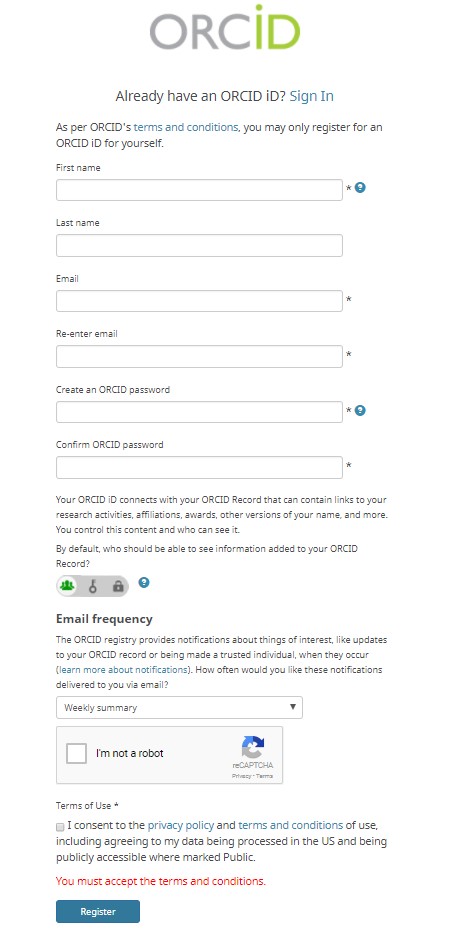
Fill out the form with your details and click 'Register' at the bottom of the page.
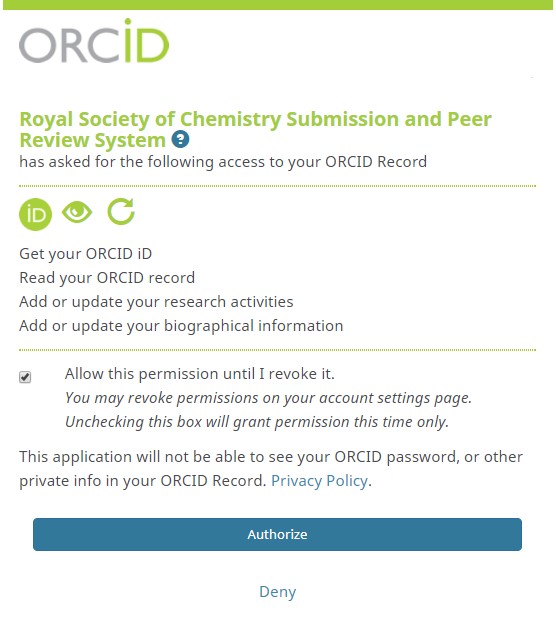
This will take you to the confirmation folio. You will need to tick the box saying 'Permit this permission until I revoke information technology' and click 'Authorize' which will take you back to your account on ScholarOne.
Skip to Stride 6.
-
If y'all already have an ORCID account and you selected 'Associate your existing ORCID iD' at step 3 y'all will exist taken to the ORCID login folio.
Sign in to ORCID using your previously registered details. This will accept you back to your account on ScholarOne.
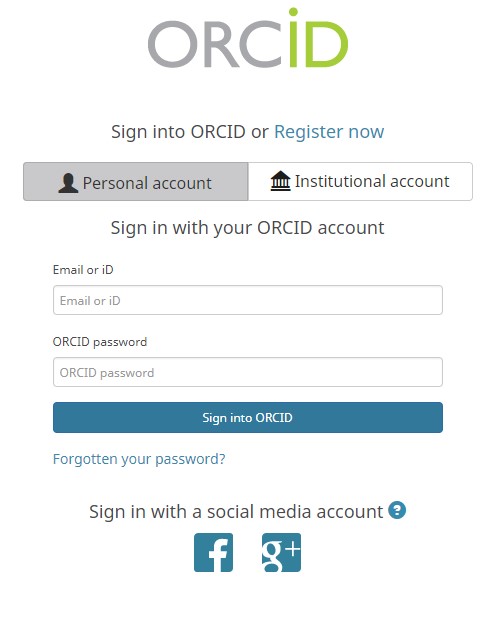
-
Click 'OK' on the popup that appears. This volition salve your account details and validate your ORCID account on ScholarOne for future use.
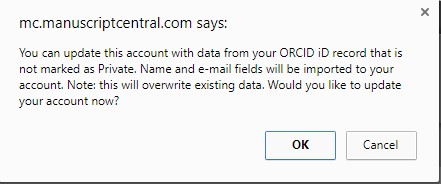
-
ORCID accounts that take been validated on ScholarOne will include your ORCID iD on your business relationship details, equally well as a green tick to show validation has been completed.
ORCIDs that are no longer valid volition be indicated here with a crimson cross.
Alternatively, y'all volition also be prompted to link your ScholarOne account to an ORCID account (if this has non already been washed) during submission of a manuscript to whatsoever of our journals.
Linking your ScholarOne and ORCID accounts in this fashion is quick and ways non having to stop your submission to validate.
If you do determine to link your ScholarOne and ORCID accounts at this stage, please follow the instructions as set out above.
Correction & retraction policy
It is our policy not to amend, alter or remove the published scientific record, in line with the International Association of Scientific, Technical & Medical Publishers' (STM) guidelines:
Manufactures that have been published should remain extant, verbal and unaltered to the maximum extent possible
(STM Guidelines on Preservation of the Objective Record of Science)
We volition respond to any suggestions of scientific misconduct or to convincing bear witness that the chief substance or conclusions of a published manuscript is erroneous, usually through consultation with the author. This may require the publication of a formal 'retraction' or correction. We follow the Commission on Publication Ethics (COPE) flowcharts equally the ground for our best practice guidelines when investigating allegations of misconduct. An expression of concern may be published by the editor whilst an investigation into alleged misconduct or publication of erroneous data is ongoing.
Authors who wish to enquire about publication of a correction for their commodity, or who have serious concern that they believe may warrant retraction, should contact the periodical editorial office.
Expression of business organization
We volition consider issuing an expression of concern if:
- we receive inconclusive evidence of inquiry or publication misconduct by the authors
- nosotros receive evidence that the findings are unreliable but the authors' institution will not investigate the case
- nosotros believe that an investigation into declared misconduct related to the publication either has not been, or would not be, fair and impartial or conclusive
- an investigation is underway but a judgement volition non be available for a considerable time.
The expression of concern is free to view and is linked to the commodity of record to which it relates.
Correction
Nosotros will consider issuing a correction if:
- the scientific record is seriously afflicted, for example with regard to the scientific accuracy of published information
- a small portion of an otherwise reliable publication proves to exist misleading (especially because of honest mistake)
- the writer/contributor list is incorrect (i.due east. a deserving author has been omitted or somebody who does not meet authorship criteria has been included).
We will not ordinarily publish a correction that does not affect the contribution in a material fashion or if the issue does not significantly impair the reader's understanding of the contribution, such as a spelling mistake or grammatical error. The correction is free to view and is linked to the article of record that it corrects.
Retraction
We will consider issuing a retraction notice if:
- we accept articulate evidence that the findings are unreliable, either as a upshot of misconduct (for example, data fabrication) or honest error (such as a miscalculation or experimental error)
- the findings have previously been published elsewhere without proper cross-referencing, permission or justification (that is, cases of redundant publication)
- the publication constitutes plagiarism
- the publication reports unethical inquiry.
The retraction notice is free to view and is linked to the article of record that information technology retracts; the commodity of tape will be digitally watermarked 'RETRACTED'.
Inappropriate or offensive content
Our aim is for all published material to exist respectful, accurate and relevant. Nosotros have a shared responsibility to guard confronting all forms of discrimination or exclusion. Every bit an author or reviewer, please consider that words, depictions and imagery have the potential to cause offence. The concept of offence/offensiveness is subjective, and may mean different things to dissimilar people, therefore there we need to consider how content might be perceived by others.
Terminology and expressed attitudes must show respect for the identity, experience and sensibilities of everyone.
Listed below are some indicators that can be used to help identify what may be concluded as inappropriate content. This list is indicative and not conclusive:
- Insulting, hostile, defamatory
- Discriminates, excludes, undermines
- Harmful, mean
- Threatening, calumniating
- Likely to be upsetting, insulting or objectionable to some or most people
- Perpetuate discriminatory and stereotypical ideas
- Harassment: unwanted [content] that makes others feel intimidated or humiliated
- Bigotry: antagonism, hostility, malice, ridicule
- Intolerance
- Aberrations: delineation of ideas, beliefs, symbols or events
- Stereotypes: stereotype threat, assumptions
- Allusion
- Derogatory demographic descriptors
- Material (images, video, sound, or text) that presents explicit/exploitive, obscene or degrading text, pictures, illustrations*
- Any content that could reasonably offend someone on the basis of their age, gender, race, sexual orientation, religious or political beliefs, marital or parental status, concrete features, national origin, social condition or inability
* We are aware that some areas of research, such equally animal experiments, can be considered controversial or offensive. Information technology is our requirement that such work has been performed co-ordinate to all relevant legal frameworks of the territory in which they take place, which will exist clearly described in the manuscript or supporting data. All information will and then exist presented in an advisable way for the scientific content.
Author name changes subsequently publication
Authors may change their name for many reasons including spousal relationship, divorce, organized religion, gender identity and other personal reasons. The Royal Social club of Chemistry is committed to respecting the rights of our authors to their ain identities, fully supporting author inclusion and ensuring that authors receive credit for all their piece of work. Information technology is therefore our policy to facilitate changes to author names, email addresses, biography photos, pronouns, and any other identifiers that may be necessary as a event of a change in author name.
These changes will exist fabricated directly to the article pdf and html. Nosotros will re-send article metadata to abstracting and indexing services such as Scopus and Web of Science, although we acknowledge that nosotros are not able to enforce replacement of the metadata on their platforms.
The RSC will retain an original version of the newspaper in its records, simply this will not be fabricated publicly available. This is to ensure that changes are made accurately and then that whatsoever changes can be reverted in future if requested.
Authors wishing to brand such changes should contact namechanges@rsc.org or the editorial office for any RSC journal in which they have published.
Please note that we volition not usually facilitate changes to correct spelling errors that were present in the author versions, out-of-date affiliation details, or changes to e-mail addresses that practise not result from name changes. We are besides unable to correct citations to papers in which a name change has been made.
Collection of gender information
We are committed to improving inclusion and variety within chemic sciences publishing. As part of our work in this area nosotros are asking authors, reviewers and editors to provide information on their gender. The information we gather volition be used to analyse trends within our journals, and to identify where improvements are needed. We inquire authors to cocky-describe their gender, and give the option of "prefer not to say".
Information on author and reviewer gender will just be visible to RSC staff and Editors, and will not be shared with external parties. Anonymised data may be collated and used in both internal and external reporting. Gender information should not be considered in any fashion when making editorial decisions on manuscripts, but we encourage our editors to use gender information to better the diversity of reviewers. For more information about how we utilise your data, delight encounter the RSC's Privacy Policy.
Nosotros are committed to improving inclusion and diverseness in all its forms, and are currently devising the near appropriate methods to collect and monitor further multifariousness information, including special category data within GDPR.
Journal policy on prior publication
As scientific research is becoming more open and discoverable, the Purple Lodge of Chemistry supports our community of chemical scientists in sharing new research findings earlier and afterwards publication through a variety of methods.
Authors publishing in our journals may nowadays their enquiry ahead of publication in the post-obit means.
- Through the deposition of a preprint version of the article in commercial and non-commercial repositories (e.g. ArXiv, ChemRxiv), institutional repositories or authors' individual websites. A preprint is defined here as an un-refereed author version of the commodity; commercial and non-commercial repositories are defined hither every bit any platform or archiving service that makes digital content costless to deposit and access. Preprints deposited in ChemRxiv can be revised, but must still be a pre-acceptance version.
- At scientific conferences; this includes recorded presentations, poster presentations and abstracts that are made openly available on-line.
- In commercial or non-commercial databases (data without interpretation, word, conclusions or context with a wider experimental project).
- In an open up electronic lab notebook.
- In blogs, wikis, tweets, and other informal communication channels.
- As a thesis or dissertation published every bit part of an academic or professional qualification, in impress and on-line.
- In whatsoever digital medium which is operated past the Regal Society of Chemistry, excluding journals, books and magazines.
We will not consider for publication work that has been previously published, or is nether consideration for publication, in another journal. Total papers every bit a follow upwards to a previously published communication will be considered for publication in suitable Royal Society of Chemistry journals, subject to the new work meeting the journal's criteria.
Please consult the journal's editor if you accept questions about whether or not a particular employ constitutes prior publication.
For information virtually what you tin can practice with your article following acceptance and publication see our guidance on deposition and sharing rights.
Data sharing policy
The Royal Society of Chemical science believes that where possible, all data associated with the research in a manuscript should exist Findable, Accessible, Interoperable and Reusable (Fair), enabling other researchers to replicate and build on that inquiry.
We strongly encourage authors to deposit the data underpinning their research in appropriate repositories.
For all submissions to Purple Society of Chemical science journals, any data required to understand and verify the inquiry in an article must be fabricated available on submission. To comply, we suggest authors deposit their data in an appropriate repository. Where this isn't possible, we ask authors to include the data equally role of the commodity Electronic Supplementary Information (ESI).
Some journals may have additional subject requirements for both sharing and/or publishing supporting data, and then please ensure y'all check the periodical specific guidelines.
Delight refer to our Experimental reporting requirements for further guidance on the experimental details and observations you should include in your manuscript or ESI.
Patents & intellectual holding
Due to our journals' fast times to publication, authors are brash to resolve any pending intellectual property or patent applications before they submit their article, then they do not contravene the terms of whatsoever outstanding applications. Accepted manuscripts are published online less than 24 hours later on acceptance; while the version of record is published online within a few days of receiving proof corrections.
mitchellcominved59.blogspot.com
Source: https://www.rsc.org/journals-books-databases/author-and-reviewer-hub/process-and-policies/

Post a Comment for "Can You Add Preferred Reviewer in Historical Biology?"